
130 Years Since the First X‑ray Experiments on Croatian Soil: A Historical‑Analytical Study of the Early Development of Radiology in Croatia
DOI:
https://doi.org/10.55378/rv.50.2.8Keywords:
radiology, X-rays, history of medicine, Croatia, archival records, institutionalization of radiologyAbstract
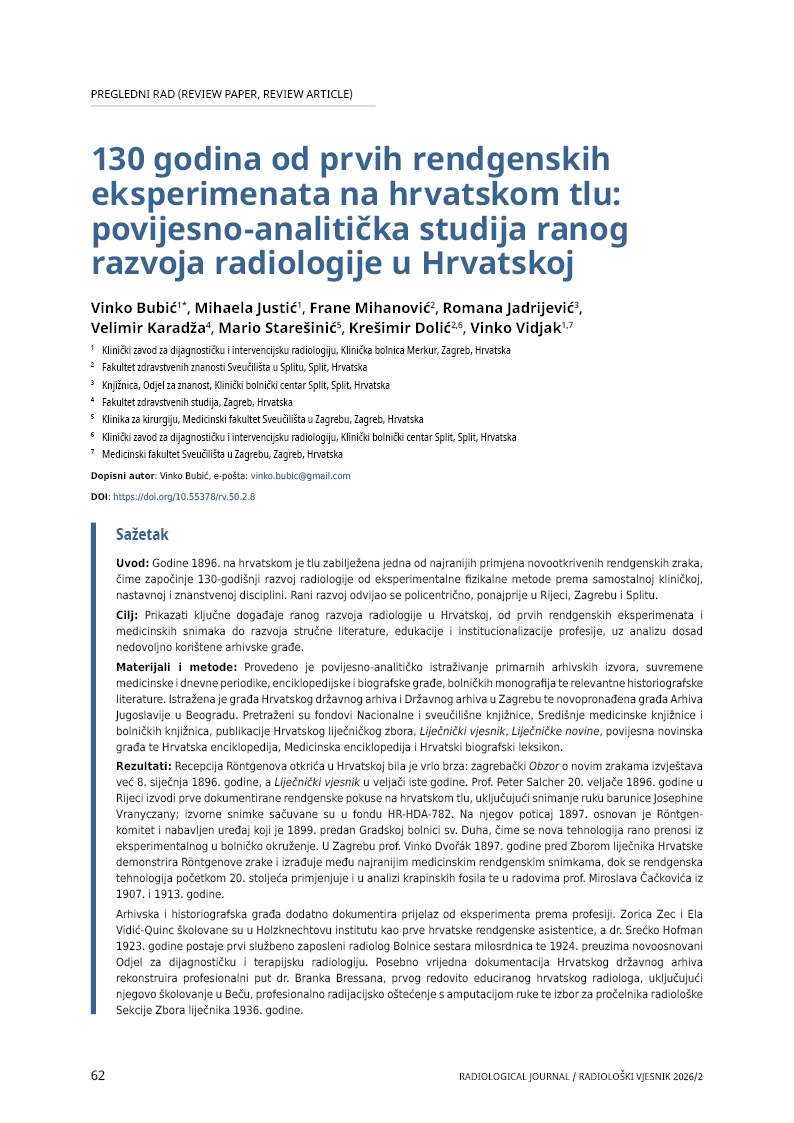
Background: In 1896, one of the earliest applications of the newly discovered X-rays was documented on Croatian territory, marking the beginning of a 130-year development of radiology from an experimental physical method into an independent clinical, academic, and scientific discipline. Its early development was polycentric, primarily involving Rijeka, Zagreb, and Split.
Objective: To present the key events in the early development of radiology in Croatia, from the first X-ray experiments and medical radiographs to the emergence of professional literature, education, and institutionalisation of the discipline, with particular emphasis on previously underused archival material.
Materials and Methods: A historical-analytical study was conducted using primary archival sources, contemporary medical and daily periodicals, encyclopaedic and biographical sources, hospital monographs, and relevant historiographical literature. Materials from the Croatian State Archives and the State Archives in Zagreb were examined, together with newly identified records from the Archives of Yugoslavia in Belgrade. The collections of the National and University Library, the Central Medical Library, and hospital libraries were searched, as were publications of the Croatian Medical Association, Liječnički vjesnik, Liječničke novine, historical newspapers, and the Croatian Encyclopedia, Medical Encyclopedia, and Croatian Biographical Lexicon.
Results: The reception of Röntgen’s discovery in Croatia was remarkably rapid: the Zagreb newspaper Obzor reported on the new rays as early as 8 January 1896, while Liječnički vjesnik published a report in February of the same year. On 20 February 1896, Prof. Peter Salcher performed the first documented X-ray experiments on Croatian territory in Rijeka, including radiographs of the hands of Baroness Josephine Vranyczany; the original images are preserved in archival collection HR-HDA-782. At his initiative, a Röntgen Committee was established in 1897 and an X-ray apparatus was acquired; in 1899, the device was transferred to the Municipal Hospital of the Holy Spirit, representing an early transition of the new technology from the experimental to the hospital setting. In Zagreb, Prof. Vinko Dvořák demonstrated Röntgen rays before the Croatian Medical Association in 1897 and produced some of the earliest medical radiographs, while in the early twentieth century X-ray technology was also applied to the study of the Krapina fossils and in the work of Prof. Miroslav Čačković, published in 1907 and 1913.
Archival and historiographical sources further document the transition from experimentation to professional practice. Zorica Zec and Ela Vidić-Quinc were trained at Holzknecht’s institute as the first Croatian X-ray assistants, while Dr Srećko Hofman became the first formally employed radiologist at the Sisters of Charity Hospital in 1923 and, in 1924, assumed leadership of the newly established Department of Diagnostic and Therapeutic Radiology. Particularly valuable documentation from the Croatian State Archives enables reconstruction of the professional career of Dr Branko Bressan, the first Croatian radiologist to receive systematic specialist training, including his education in Vienna, occupational radiation injury resulting in amputation of an arm, and his election as head of the Radiology Section of the Croatian Medical Association in 1936.
Institutionalisation continued with the establishment of the Chair of Roentgenology at the University of Zagreb School of Medicine in 1921 under Laza Popović and the Central Institute of Roentgenology in 1927. Between 1923 and 1935, Popović published the four-volume Clinical Roentgenology (Klinička rentgenologija), and from 1937 he edited Radiološki glasnik. His personnel files in the Croatian State Archives also document an occupational disease caused by prolonged exposure to X-rays, which led him to request retirement in 1939. Newly identified material from the Archives of Yugoslavia in Belgrade, particularly Popović’s Account of the Establishment and Development of the Central Institute of Roentgenology of the University of Zagreb School of Medicine and the original floor plan of the Institute, further documents the deliberate integration of diagnostics, therapy, teaching, and scientific research.
In Dalmatia, an X-ray apparatus was introduced at Dr Jakša Račić’s sanatorium in Split as early as 1902–1903, and by 1909 a separate “Röntgen Institute” was operating there. In 1930, Split hosted the Third Congress of the Pan-Slavic Association for Roentgenology and Radiology and the first meeting of the Yugoslav Society of Roentgenology and Radiotherapy, while the municipal hospital acquired its own X-ray apparatus in 1940.
Conclusion: X-ray technology was adopted in Croatia very shortly after Röntgen’s discovery, and its development followed a polycentric pattern through interconnected initiatives in Rijeka, Zagreb, and Dalmatia. The transition from physical experimentation to an independent medical discipline was achieved through the integration of clinical practice, university teaching, specialist education, professional organisation, and public health needs. Newly identified archival material further expands the existing historiography, particularly by documenting the professional trajectories of early radiologists and the spatial and organisational development of the Central Institute of Roentgenology in Zagreb. The early development of Croatian radiology can therefore be understood as a process of simultaneous technological, professional, and institutional modernisation of medicine.
References
Wilhelm Conrad Röntgen 1895–2020: Eine Ausstellung der Universität Würzburg. Würzburg: Julius-Maximilians-Universität Würzburg; 2020.
Haschek E, Lindenthal OT. Ein Beitrag zur praktischen Verwerthung der Photographie nach Röntgen. Wien Klin Wochenschr. 1896;9(4):63–4.
Senzacionalno odkriće. Obzor. 8. 1. 1896.
Röntgenovi traci. Lijec Vjesn. 1896;18(2):41–2.
Alebić-Juretić A. Prof. Peter Salcher – manje znani stavovi o zdravlju. Acta Med Hist Adriat. 2007;5(2):237–44.
Matejčić R, Matejčić M. Ars Aesculaopii: prilozi za povijest zdravstvene kulture Rijeke i Hrvatskog primorja. Rijeka: Izdavački centar Rijeka; 1982.
Bagarić M, ur. Veličanstveni Vranyczanyjevi: umjetnički, povijesni i politički okvir života jedne plemićke obitelji. Zagreb: Muzej za umjetnost i obrt; 2016.
Hondl S. Dvořák, Vinko. U: Ujević M, ur. Hrvatska enciklopedija. Sv. 5: Dilatacija–elektrika. Zagreb: Naklada Hrvatskog izdavalačkog bibliografskog zavoda; 1945. Str. 503–5.
Keros P, ur. Povjesnica Zdravstvenog veleučilišta u Zagrebu: 1966.–2016. Zagreb: Zdravstveno veleučilište; 2016.
Janković S, ur. Klinički zavod za radiologiju Kliničke bolnice Split: 1982–2002, prva dva desetljeća: povodom stote obljetnice radiologije u Splitu i dvadesete obljetnice Kliničkog zavoda za radiologiju. Split: Klinička bolnica, Jedinica za znanstveni rad; 2002.
Boschi S. Radiologija na III sveslavenskom liječničkom kongresu u Splitu 1930. godine. Acta historiae medicinae, stomatologiae, pharmaciae, medicinae veterinariae. 1991;31(1–2):115–8.
Šimunković M. Povijest slobodne organizacije liječnika Dalmacije. Lijec Vjesn. 1957;79(9–10):446–57.
Fatović-Ferenčić S, Hofgräff D. Arhivska vrela o Srećku Hofmanu – prvom rendgenologu Bolnice milosrdnih sestara u Zagrebu. Medicus. 2011;20(1):129–36.
Simunic S, Glavina K, Besenski N, Klaric-Custovic R. Croatian Society of Radiology (1928–2008), the Croatian Medical Association – 80 years of existence and activity. Radiol Oncol. 2011;45(2):147–58.
Pećina M, Klarica M, ur. Medicinski fakultet, Sveučilište u Zagrebu: 1917–2017. Zagreb: Medicinski fakultet Sveučilišta u Zagrebu; 2017.
Smokvina M. Popović, Laza. U: Šercer A, Grmek MD, ur. Medicinska enciklopedija. 2. izd. Sv. 5: O–Sok. Zagreb: Jugoslavenski leksikografski zavod; 1970. Str. 323.
Čačković M. Nekoliko rijedkih Röntgen-nalaza. Lijec Vjesn. 1907;29(10):269–75.
Čačković M. O topografiji i funkciji normalnih probavnih organa na temelju röntgenoložke pretrage, te o lokalizaciji stranih tjelesa u njima. Lijec Vjesn. 1913;35(3):90–102.
Grmek MD, Budak A. Uvod u medicinu. 3., prerađeno i dopunjeno izd. Zagreb: Nakladni zavod Globus; 1996.
Club di scienze naturali. La Bilancia. 24. veljače 1896. Str. 2.
Rendgenske snimke ruku Josephine Vranyczany. Hrvatski državni arhiv, Zagreb, HR-HDA-782: Obitelj Vranyczany-Dobrinović.
Petrovčić F. Početci dijagnostike rentgenologije u Hrvatskoj. U: Grmek M, ur. Iz hrvatske medicinske prošlosti: spomen-knjiga Zbora liječnika Hrvatske. Zagreb: Zbor liječnika Hrvatske; 1954. Str. 291.
Štrkalj G. X-raying human origins: Dragutin Gorjanovic-Kramberger and the first application of radiography in palaeoanthropology. Adler Museum Bulletin. 2000;26(3):4–7.
Hrvatski državni arhiv, Zagreb. HR-HDA-890: Personalni spisi državnih službenika Zemaljske vlade, Pokrajinske uprave, oblasnih uprava, Savske banovine, Banovine Hrvatske i ministarstava NDH. Dokumentacija Branka Bressana.
Personalije Srećka Hoffmanna. 1924.–1945. Hrvatski državni arhiv, Zagreb, HR-HDA-890: Personalni spisi državnih službenika Zemaljske vlade, Pokrajinske uprave, oblasnih uprava, Savske banovine, Banovine Hrvatske i ministarstava NDH, dosje br. 11735 Hoffman Srečko (BH).
Personalije Lazara Popovića. Hrvatski državni arhiv, Zagreb, HR-HDA-890: Personalni spisi državnih službenika Zemaljske vlade, Pokrajinske uprave, oblasnih uprava, Savske banovine, Banovine Hrvatske i ministarstava NDH, dosje br. 309 Popović Lazar (BH).
Popović L. Prikaz postanka i razvitka Centralnog rentgenološkog instituta Medicinskog fakulteta u Zagrebu [arhivska građa]. Arhiv Jugoslavije, Beograd, Ministarstvo prosvete Kraljevine Jugoslavije, fond 66, AJ-66-417-676.
Popović L. Plan Centralnog rentgenološkog instituta Medicinskog fakulteta u Zagrebu [planski nacrt]. Arhiv Jugoslavije, Beograd, Ministarstvo prosvete Kraljevine Jugoslavije, fond 66, AJ-66-417-676.
Popović L. Specijalistički ispit. Radiološki glasnik. 1937;1(2):140–1.
Gvozdanović V. Naša iskustva s fluorografijom. Lijec Vjesn. 1947;69(3–5):73–7.
Downloads
Published
Issue
Section
License
Copyright (c) 2026 Vinko Bubić (Author); Mihaela Justić, Frane Mihanović, Romana Jadrijević

This work is licensed under a Creative Commons Attribution-NonCommercial 4.0 International License.
 CART