
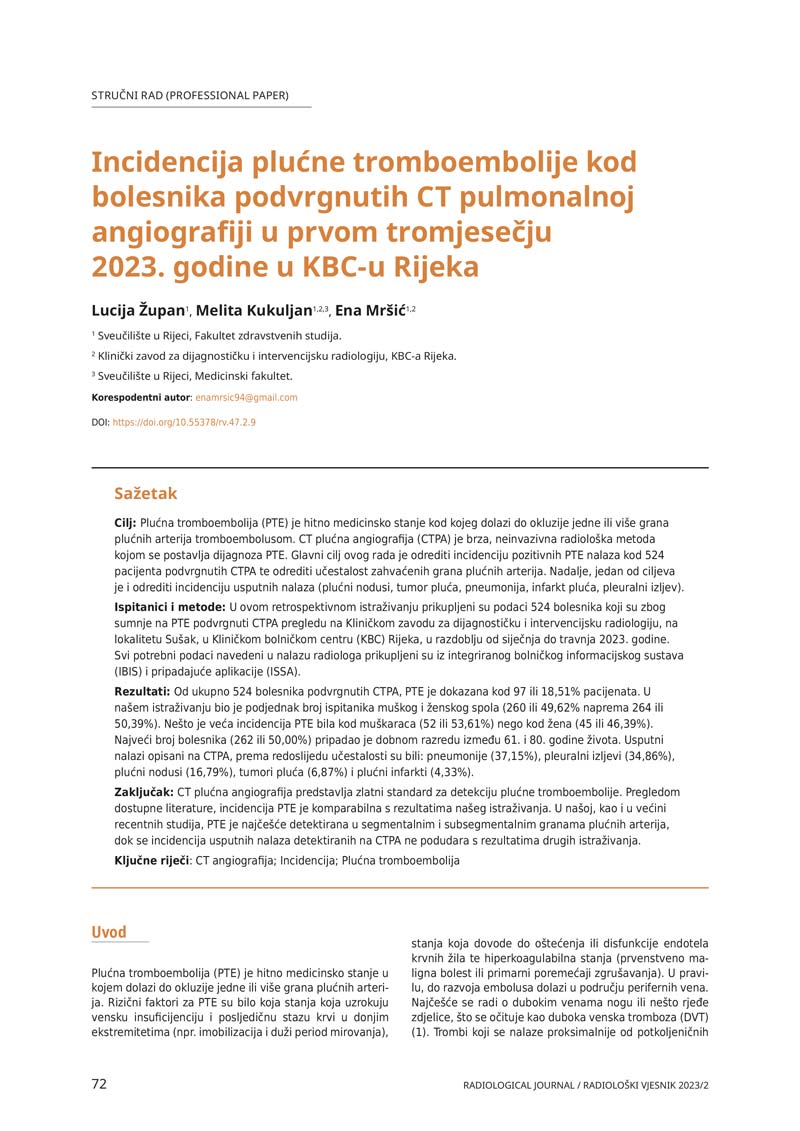
Incidence of pulmonary thromboembolism in patients who underwent CT pulmonary angiography in the first quarter of 2023 at CHC Rijeka
DOI:
https://doi.org/10.55378/rv.47.2.9Keywords:
CT angiography, Incidence, Pulmonary thromboembolismAbstract
Aim: Pulmonary thromboembolism (PTE) is an urgent medical condition in which one or more branches of the pulmonary arteries are occluded by an embolus. CT pulmonary angiography (CTPA) is a rapid, non-invasive radiological method used to diagnose PTE. The main goal of this research was to determine the incidence of positive PTE findings in 524 patients who underwent CTPA, and to determine the frequency of affected branches of the pulmonary arteries. Furthermore, one of the goals was to determine the frequency of incidental findings (lung nodules, lung tumor, pneumonia, lung infarction, pleural effusion).
Methods: In this retrospective study, data was collected on 524 patients, who due to suspicion of PTE, underwent CTPA at the Clinical Department for Diagnostic and Interventional Radiology, at the Clinical Hospital Center (CHC) Rijeka, in the period from January to April 2023. All the necessary data specified in the radiologist’s report was collected from the hospital database and the associated application (ISSA).
Results: A total of 147 diagnosed primary lung cancers were detected in this study. Lung cancer showed a male predominance with 65,3% while the proportion of female patients was 34,7%. The most common histological type of lung cancer was adenocarcinoma, confirmed in 40,8% of patients, followed by squamous cell carcinoma, which was diagnosed in 22,4% of patients. The male gender was more prevalent in patients with adenocarcinoma and squamous cell carcinoma, with the incidence of 63,3% and 75,5%. Analysis of the smoking status showed that 80% of patients with adenocarcinoma and 94% of patients with squamous cell carcinoma were smokers. The incidence of smokers among men diagnosed with adenocarcinoma and squamous cell carcinoma was approximately equal (92.2% vs. 92%). The proportion of smokers among women with adenocarcinoma was 59.1% while all women with squamous cell carcinoma were smokers.
Conclusion: Squamous cell carcinoma was the second most common histological type in patients diagnosed with lung cancer in 2022 at CHC Rijeka, after adenocarcinoma, with the incidence of 22.4%. Squamous cell carcinoma showed a significantly higher incidence in male patients (75,8% vs. 24,2%). Furthermore, the proportion of smokers was higher among the patients diagnosed with squamous cell carcinoma compared to those diagnosed with adenocarcinoma (94% versus 80%).
References
Turetz M, Sideris AT, Friedman OA, Triphathi N, Horowitz JM. Epidemiology, Pathophysiology, and Natural History of Pulmonary Embolism. Semin Interv Radiol. 2018 Jun;35(2):92–8.
Weitz JI, Lensing AWA, Prins MH, Bauersachs R, Beyer-Westendorf J, Bounameaux H, et al. Rivaroxaban or Aspirin for Extended Treatment of Venous Thromboembolism. N Engl J Med. 2017 Mar 30;376(13):1211–22.
Mayo Clinic. Pulmonary embolism – Symptoms and causes. Available from: https://www.mayoclinic.org/diseases-conditions/pulmonary-embolism/symptoms-causes/syc-20354647.
Korkut M, Bedel C, Erman K, Yüksel S. Incidental Findings of Computed Tomography Angiography in Patients Suspected to Pulmonary Embolism; a Brief Report. Arch Acad Emerg Med. 2019;7(1):e60.
Chen Z, Deblois S, Toporowicz K, Boldeanu I, Francoeur MO, Sadouni M, et al. Yield of CT pulmonary angiography in the diagnosis of acute pulmonary embolism: short report. BMC Res Notes. 2019 Jan 18;12:41.
Hutchinson BD, Navin P, Marom EM, Truong MT, Bruzzi JF. Overdiagnosis of Pulmonary Embolism by Pulmonary CT Angiography. Am J Roentgenol. 2015 Aug;205(2):271–7.
Deblois S, Chartrand-Lefebvre C, Toporowicz K, Chen Z, Lepanto L. Interventions to Reduce the Overuse of Imaging for Pulmonary Embolism: A Systematic Review. J Hosp Med. 2018 Jan;13(1):52–61.
Cha SI, Shin KM, Lee J, Hwangbo Y, Yoo SS, Lee J, et al. Clinical relevance of pulmonary infarction in patients with pulmonary embolism. Thromb Res. 2012 Sep 1;130(3):e1–5.
Kaptein FHJ, Kroft LJM, Hammerschlag G, Ninaber MK, Bauer MP, Huisman MV et al Pulmonary infarction in acute pulmonary embolism. Thromb Res. 2021 Jun 1;202:162–9.
Kino A, Boiselle PM, Raptopoulos V, Hatabu H. Lung cancer detected in patients presenting to the Emergency Department studies for suspected pulmonary embolism on computed tomography pulmonary angiography. Eur J Radiol. 2006 Apr 1;58(1):119–23.
Liu M, Cui A, Zhai ZG, Guo XJ, Li M Teng LL et al Incidence of Pleural Effusion in Patients with Pulmonary Embolism. Chin Med J (Engl). 2015 Apr 20;128(8):1032–6.
Downloads
Published
Issue
Section
Categories
License
Copyright (c) 2023 Lucija Župan, Melita Kukuljan, Ena Mršić (Autor)

This work is licensed under a Creative Commons Attribution-NonCommercial 4.0 International License.
 CART